
Want to reach your goals but keep falling off track? Here is why discipline and consistency matter more than motivation — and exactly how to build both.
Table of Contents
- Why Discipline and Consistency Matter
- What Is Discipline?
- What Is Consistency?
- Why We Struggle With Both
- Motivation vs Discipline: The Key Difference
- How to Build Discipline (3 Practical Steps)
- How to Build Consistency (3 Practical Steps)
- What Happens When You Stay the Course
- FAQs About Discipline and Consistency
Why Discipline and Consistency Matter {#why-they-matter}
Most of us have big goals. We want to get fit, learn something new, save money, build a business, or simply become a better version of ourselves. We feel the fire. We make the plan. We start strong.
And then life happens. We skip one day. Then two. Then the plan quietly disappears.
Sound familiar? You are not alone.
The problem is not that you are lazy. The problem is that nobody taught us the two skills that matter more than motivation, talent, or even opportunity: discipline and consistency.
This blog will show you what they really mean, why they are so hard, and how you can actually build them — starting today.
What Is Discipline? {#what-is-discipline}
Discipline means doing what you said you would do, even when you do not feel like doing it.
That is it. No magic. No secret formula.
When your alarm rings at 6 AM and your body wants to stay in bed, discipline is what gets you up. When you are tired after a long day but promised yourself 20 minutes of reading, discipline opens the book.
Self-discipline is not about being harsh on yourself. It is not about pressure or punishment. It is about keeping a promise to yourself.
Think of it this way: if a good friend asked for your help and you said yes, you would show up — even if you were tired, even if it was inconvenient. Because your word means something.
Discipline is treating yourself with that same respect. Your goals deserve the loyalty you already give to others.
Key takeaway: Discipline is a skill, not a personality trait. Anyone can learn it.
What Is Consistency? {#what-is-consistency}
If discipline is showing up, consistency is showing up again and again.
Consistency is not about being perfect. It is about being regular.
One great workout does not make you healthy. One good savings day does not make you financially free. But doing these things regularly — over weeks, months, and years — is when real change happens.
Consistency works because of compounding. Small actions, repeated over time, grow into something far bigger than they look at the start.
Here is a simple example: if you improve just 1% every single day for one year, you will be 37 times better than when you started. That is the math of consistency. Small daily steps lead to extraordinary long-term results.
Key takeaway: Consistency beats intensity. Doing something small every day beats doing something big once in a while.
Why We Struggle With Discipline and Consistency {#why-we-struggle}
Here is the honest truth: discipline and consistency are hard because our brains are not naturally wired for them.
Our brains love comfort. They are drawn to what feels easy, familiar, and rewarding right now. The gym is hard. Saving money feels like loss. Waking up early is uncomfortable.
So the brain sends thoughts like:
- “Start tomorrow.”
- “You deserve a break today.”
- “One day off won’t really matter.”
These thoughts feel completely reasonable in the moment. But here is what we miss: every choice you make today shapes the future version of you. Every time you skip, that future version gets a little further away. Every time you show up, they get a little closer.
Building discipline and consistency is, at its core, an act of care for your future self.
Motivation vs Discipline: The Key Difference {#motivation-vs-discipline}
Many people wait for motivation before they begin. They feel they need to feel ready, feel inspired, or feel energized before taking action.
But motivation is unreliable. It comes and goes. It is emotional. It is not something you can count on.
Discipline does not wait for feelings. It acts in spite of them.
A professional writer does not write only when the words flow easily. They sit down and write every day, good day or bad. A professional athlete does not train only when they feel like it. They show up when their legs are sore and their mind is tired.
Here is the real secret: action creates motivation, not the other way around. Start the work, and the feeling will often follow. Wait for the feeling first, and you may wait a very long time.
How to Build Discipline: 3 Practical Steps {#how-to-build-discipline}
Step 1: Start Smaller Than You Think You Should
The most common mistake when building self-discipline is starting too big. People want to get fit, so they attempt an intense one-hour workout on day one. They want to read more, so they commit to an hour each night.
Then it feels too hard. They miss a day. They quit.
Start ridiculously small. Want to exercise? Start with 5 minutes. Want to read? Start with one page. Want to write? Start with one sentence.
The point is not the result right now. The point is building the habit of showing up. Once showing up is automatic, you can gradually increase.
Step 2: Remove the Decision
Every time you have to decide whether to do something, your brain gets a chance to talk you out of it. The solution is to remove the decision entirely.
Lay your workout clothes out the night before. Put your book on your pillow. Block time on your calendar for your most important tasks. When there is no decision to make, it is far easier to just do the thing.
Step 3: Focus on Identity, Not Just Goals
Instead of saying “I want to lose weight,” say “I am someone who takes care of my body.”
Instead of “I want to read 20 books this year,” say “I am a reader.”
When your goal becomes part of who you are, showing up becomes natural. You are not forcing yourself to do something. You are just being yourself.
How to Build Consistency: 3 Practical Steps {#how-to-build-consistency}
Step 1: Same Time, Same Place
Consistency thrives on routine. When you do something at the same time and in the same place every day, it becomes automatic. Your brain stops debating it. It just happens.
Pick a time for your habit and protect it. Morning, lunch break, or evening — whatever fits your life. The important thing is to pick one and stick to it.
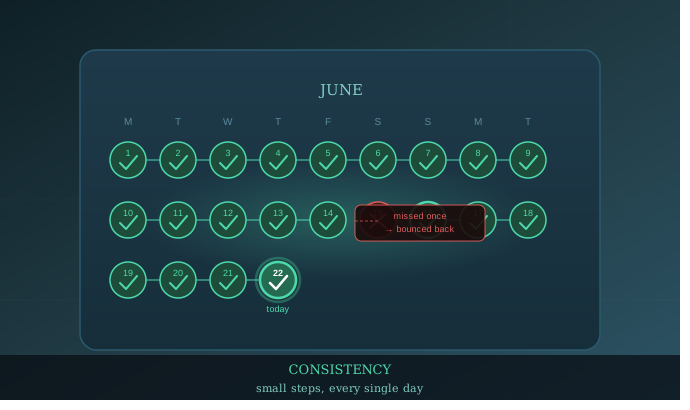
Step 2: Never Miss Twice in a Row
You will miss a day. That is not failure. That is life.
The rule that changes everything is simple: never miss twice in a row. One missed day is an accident. Two missed days is the beginning of a new (bad) habit.
When you miss, acknowledge it, forgive yourself, and show up the very next day. That is what real consistency looks like — not perfection, but persistence.
Step 3: Track Your Habit Visually
There is something powerful about marking a calendar or ticking a box. It feels good. And that good feeling motivates you to keep the streak going.
You do not need a fancy app. A simple piece of paper on your wall works perfectly. Every day you show up, mark it. Watch the chain grow. Do not break the chain.
What Happens When You Stay the Course {#stay-the-course}
Here is what most people never see: the results of discipline and consistency are almost always invisible at first.
You exercise for two weeks and see no change in the mirror. You save a little money each month and it feels like nothing. You practice a skill and still feel like a beginner.
This is the danger zone. This is where most people quit, assuming it is not working.
But it is working. Beneath the surface, things are changing. Your body is adapting. Your savings are growing. Your skill is developing. It is just slow — too slow to see day to day.
And then one day, something shifts. People notice a change in you. The bank account looks different. Something that was hard six months ago now feels easy. You have crossed the threshold.
This moment — the breakthrough — only comes to people who did not quit before it arrived.
The winners are not always the most talented. They are the ones who simply kept going.
FAQs About Discipline and Consistency {#faqs}
Q: What is the difference between discipline and consistency?
Discipline is choosing to do something even when you do not feel like it. Consistency is doing that repeatedly over time. You need both — discipline gets you started on the hard days, and consistency builds the long-term results.
Q: How long does it take to build a consistent habit?
Research suggests it takes anywhere from 21 to 66 days to form a habit, depending on the person and the habit. The key is not to focus on the number of days — focus on showing up today.
Q: Can discipline be learned, or is it something you are born with?
Discipline is absolutely a skill you can learn. Like a muscle, it grows stronger the more you use it. Start small, stay patient, and it will grow.
Q: What should I do when I feel like giving up?
Remind yourself why you started. Look back at how far you have come. And remember: you do not have to feel motivated to take action. Do the smallest possible version of your habit — even 2 minutes — just to keep the chain alive.
Q: Is motivation or discipline more important for success?
Discipline is far more reliable. Motivation is a feeling that comes and goes. Discipline is a decision you make regardless of how you feel. Long-term success is built on discipline, not motivation.
Final Thoughts: Start Today, Not Tomorrow
Discipline and consistency are not glamorous. They do not make exciting social media posts. Nobody claps for you when you wake up on time, go to bed early, or say no to something that distracts you.
But they work. Quietly. Reliably. Without exception.
You do not need to be the most talented person. You do not need the perfect plan or the best circumstances. You just need to show up — today, tomorrow, and the day after that.
The person who does that consistently? They win. Every single time.
So start today. Not perfectly. Not dramatically. Just start. One small step in the right direction.
Your future self is already grateful.